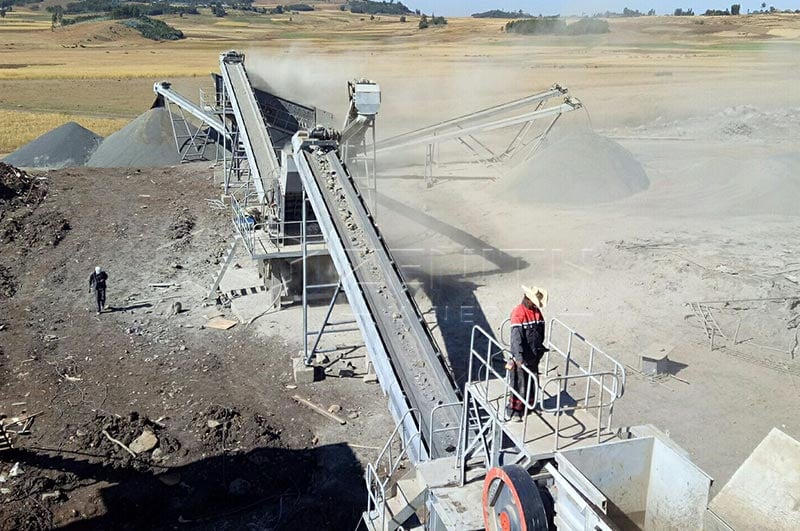
A stone production line is a coordinated system involving feeders, crushing equipment, screening units, conveyors, and dust-control mechanisms. Crushers are the backbone of this system, responsible for breaking down large marble stones into specific sizes suitable for construction aggregates, decorative stone, or industrial raw materials.
The production line generally starts with a vibrating feeder that channels large marble blocks into the primary crusher. Each crusher stage progressively reduces the stone size while refining shape and minimizing impurities.
After the crushing stages, vibrating screens classify materials into various size ranges, and conveyors transport the final aggregates to storage or further processing units.
Jaw crushers apply compressive force between a fixed and moving jaw, ideal for primary crushing of coarse marble up to 425mm with high capacity of 45-400 t/h. They suit hard, abrasive marble, producing coarse output for downstream processing.
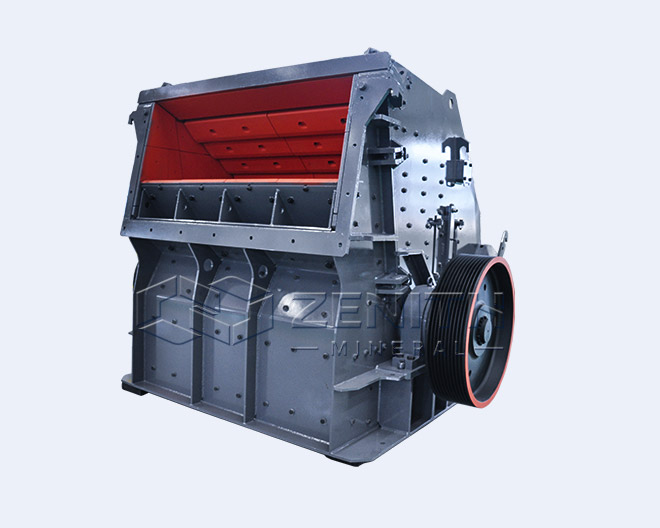
Impact crushers use high-speed rotors and blow bars to strike medium-hard marble, creating cubic grains excellent for shaping in secondary or fine stages. Best for limestone-like marble or contaminated waste, they offer good particle shape and efficiency.
Cone crushers employ interparticle compression via a rotating cone in a fixed chamber, perfect for high-hardness marble in secondary/tertiary crushing with precise gap control (8-18mm). They deliver high throughput and uniform 10-30mm fragments with ≥85% cubicity.
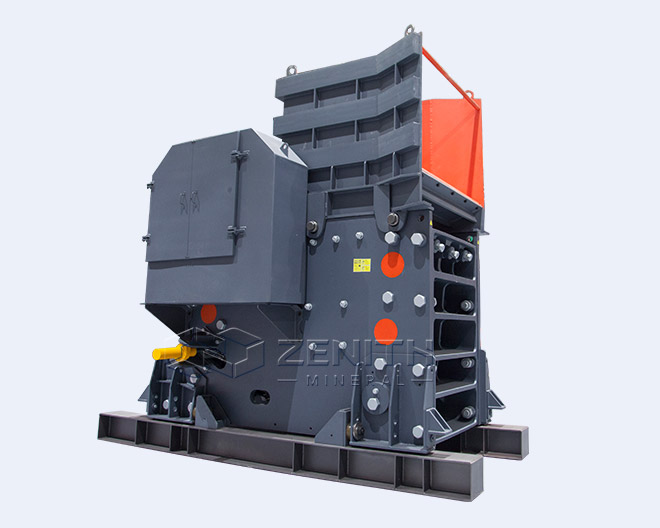
Hammer crushers feature rotating hammers impacting marble against plates, suited for fine crushing or small-scale dry/wet operations on low-to-medium hardness material. They handle moisture up to 15% for quick size reduction.
Mobile units combine jaw, cone, or impact crushers on chassis for on-site flexibility, reducing transport costs in quarries. They enable primary-to-fine processing with stable mobility.
Despite their robustness, marble crushers face operational hurdles due to the material's abrasiveness and variability. Addressing these proactively through maintenance extends equipment life by 20–30% and cuts downtime. Below are prevalent issues, causes, solutions, and preventive tips.
Solution: Inspect visually every shift; replace with high-manganese steel liners when thickness drops 20%. Preventive: Schedule bi-weekly checks and use automated wear sensors. Lubricate pivot points to minimize friction.
Solution: Install load sensors to auto-adjust feeder speeds; clear jams immediately with hydraulic lifts. Preventive: Train operators on capacity limits (e.g., 80% max) and maintain daily logbooks for feed rates.
Solution: Use vibratory knockers or high-pressure air blasts for quick clearance; redesign chutes with steeper angles. Preventive: Pre-screen quarry input and apply anti-stick coatings; perform end-of-shift cleanouts.
Solution: Fine-tune closed-side settings (e.g., 15–20 mm gap on jaws) and recirculate fines via screens. Preventive: Match crusher type to marble hardness—use impacts for less fines—and monitor moisture to under 5%.
Solution: Balance rotors professionally; tighten bolts to spec. Preventive: Daily vibration checks with portable meters; quarterly full alignments and grease replenishment per OEM schedules.
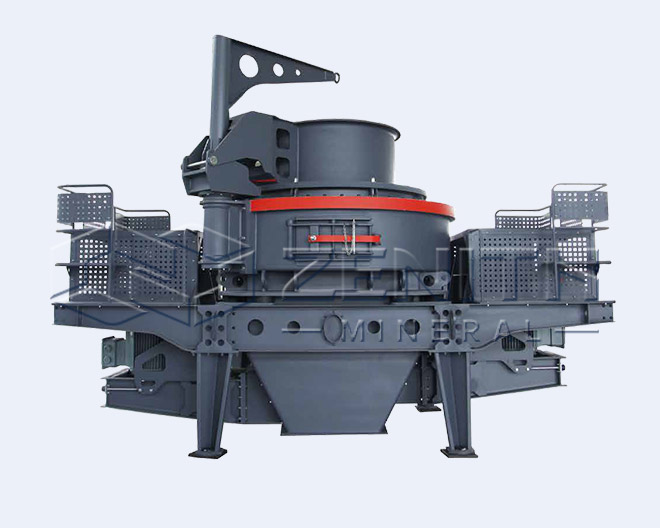
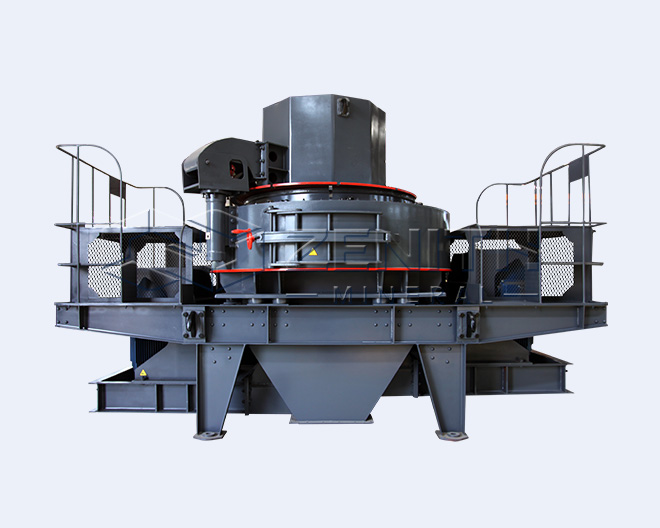
Cette installation de concassage mobile a été performante et stable, attirant de nombreux clients des environs depuis la mise en service.
Apprendre plus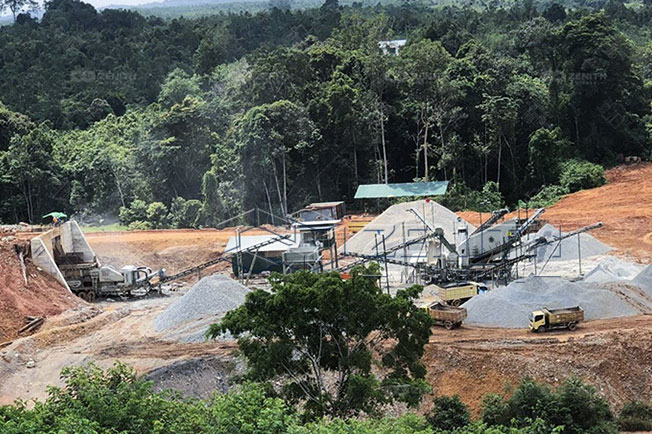
Ce client est une entreprise de construction, une entreprise locale aux Émirats arabes unis. La première fois que nous avons établi un co
Apprendre plus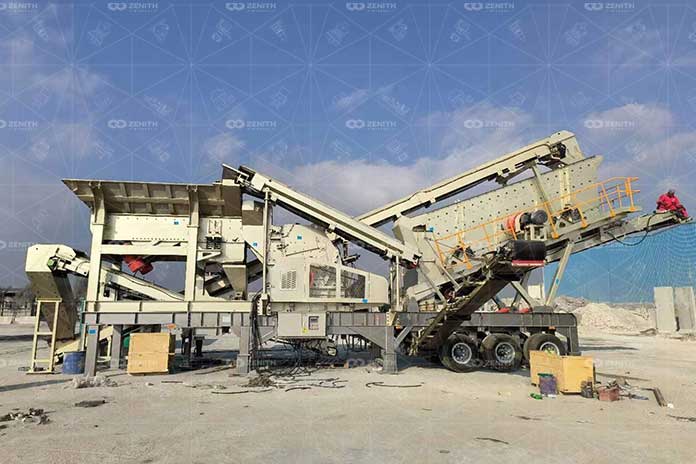
Ce client a été référé par un intermédiaire et, en raison de ses besoins de livraison urgents, il a opté pour une installation de con
Apprendre plus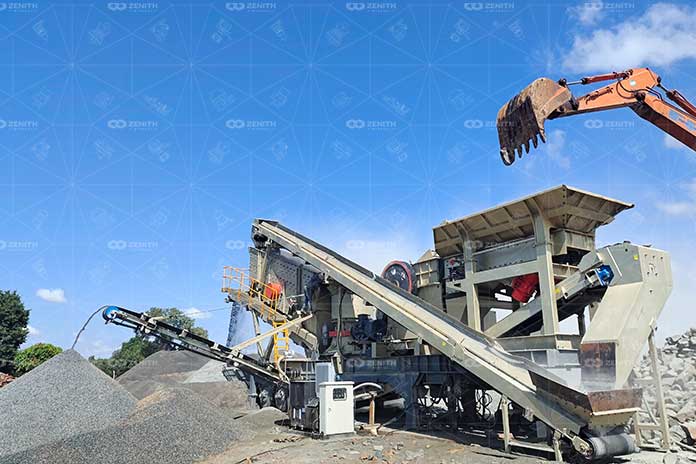
 Plus rapide et plus sûr
 Visite sur site gratuite
 Conception personnalisée
 Installation et formation
 Fourniture de pièces de rechange
 Support technologique
Laissez votre message ici, nous vous enverrons immédiatement un e-mail.
Shanghai Zenith Société © 2000-2026 droit de copie.sitemap

 WhatsApp
 +86-21-58386256
 +86 13611890592
 Français
 Obtenir la solution
 Obtenez le devis
 WhatsApp